Apollo Kagwa and Lillian
The ChangelingApollo Kagwa and Lillian’s relationship turns on a belated truth: Lillian reveals that Brian West tried to kill their young son, while Apollo comes to understand both the danger Brian posed and the mother who protected him. Their conversation begins as a possible farewell before Apollo returns to the forest, but becomes an act of explanation and recognition that alters how he understands his parents and his own childhood.
A call before the cave
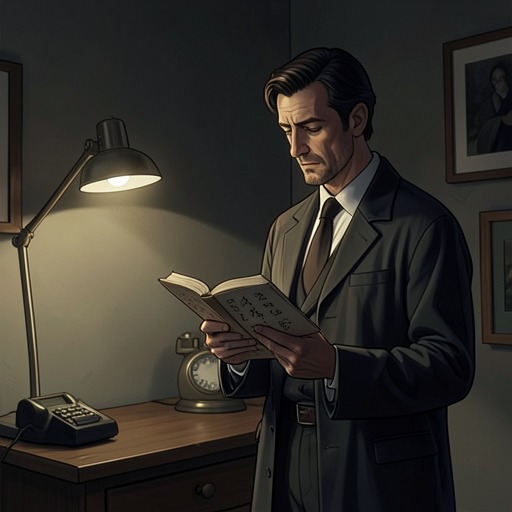
With Emma Valentine asleep upstairs, Apollo retrieves his phone and prepares to call Lillian. He and Emma intend to go back into the forest and enter the cave; he considers that they might not return. The possibility gives the call its urgency: before risking another disappearance, Apollo does not want to leave without saying goodbye to his mother. His immediate purpose is not to reopen their dispute, but the call brings him into the unresolved history behind it.
Lillian answers in a whisper, struggling to speak. Apollo asks how she is, then describes events as having become wild. Lillian responds with guilt, saying she had left him alone and that things went wrong after that. The exchange places responsibility and care in the same moment: she fears that her absence mattered, while Apollo has called not to accuse her but to make contact before facing danger.
Lillian recalls their last conversation, when Apollo was angry with her. She says she understood his anger, had continued thinking about what each of them had said, and had withheld explanations in the hope she would never need to give them. The call therefore begins against a history of silence, but neither treats that silence as proof that the relationship has ended. Apollo listens, and Lillian tries to tell him what she had not told him before.
Lillian’s account of the past
Lillian first explains why she is wary of the stories people tell about themselves. She describes a man who, after recounting an encounter several times, came to believe a self-flattering version in which he had never pressured her for a date. She does not call his account a straightforward lie; rather, she sees how a person can settle into the version that protects his own image. That reflection leads her to consider that, by telling Apollo nothing about his father, she may also have preserved a story that served Brian as well as herself.
She then recounts coming home from work at one o’clock with McDonald’s for the two of them, partly because she felt guilty and knew Apollo liked the French fries. The unlocked front door immediately seemed wrong. Hearing the bath running, she panicked, dropped what she was carrying, and hurried to check whether Apollo was safe. What she found was Brian holding Apollo under the water. Lillian stops while trying to describe the scene; she later states plainly that Brian had tried to kill Apollo, and that he had planned to kill her and then himself.
The explanation is tied to Lillian’s decision to leave. She had served Brian with divorce papers and intended to take Apollo with her. As she describes it, Brian had long imagined the family he wanted, shaped by a terrible childhood and by his wish to make up for what he had missed. But the ideal he had formed as a twelve-year-old could not accommodate adult change or Lillian’s decision to end the marriage. His longing for a family did not prevent him from endangering the family he had made.
Love and harm held together
Apollo connects Lillian’s account to the book found in the box. He had understood the book as part of what Brian had left behind; Lillian offers another way to read its significance. Brian feared losing his son and identified with a child taken by Goblins who never had an Ida come to rescue him. Lillian says that this was why Brian kept the book and wanted to read it to Apollo: in Brian’s imagined story, he would come for his child.
Her explanation refuses to make the book a simple sign of tenderness or to let Brian’s violence erase his love. Brian loved Apollo wholeheartedly, Lillian says, and also tried to take his life; both facts are true. This contradiction is central to what she asks Apollo to understand. The father’s affection cannot undo the danger, and the danger does not make the affection unreal. Lillian does not dictate what Apollo must think of either parent. She insists instead that he should know the whole account, because understanding requires more than the version that is easiest to bear.
Apollo absorbs the disclosure as a judgment on childhood itself, remarking on how astonishing it is that anyone survives it. Lillian turns from Brian’s history to Apollo’s identity: whoever his father became, Apollo is not him, and she is proud of the man her son has become. Her reassurance separates inheritance from destiny. The painful account of Brian is not offered as a forecast of Apollo’s character, but alongside Lillian’s confidence in the person he has become.
Recognition and continuing connection
The call changes Apollo’s understanding of where his loyalty and attention have been directed. He tells Lillian that he spent his whole life chasing his father, but that she was the one who had always been there. The contrast does not erase his attachment to Brian or make the history simple; it names how Apollo’s pursuit of the absent father had obscured the presence of his mother. Lillian answers that she was where she wanted to be, making her care a chosen commitment rather than a duty she regrets.
The exchange is not a complete resolution of their past. Apollo had been angry, Lillian had withheld the truth, and the conversation occurs under the pressure of a dangerous journey they are about to undertake. Nor does the account establish everything that followed the attack: when Apollo asks what happened after Lillian found them, her response begins by rejecting the idea that she would simply have sent a man who harmed her child away. What the conversation does establish is a new ground for their relationship. Lillian speaks without demanding that Apollo adopt a single judgment of Brian, and Apollo can acknowledge the mother whose presence had endured while he searched for his father.
Their reconciliation is therefore founded not on forgetting or on a neat division between a loving father and a protective mother, but on fuller knowledge. Lillian’s candor gives Apollo a history that includes Brian’s childhood, his imagined family, his attempt on Apollo’s life, and her own decision to leave. Apollo’s answer recognizes her not merely as the keeper of that history but as the person who remained beside him. In a story organized around disappearance and the possibility of being lost, the call makes maternal presence newly visible.